End-of-Year Celebration Recap

June 18, 2025

        Last Friday, June 13th, 2025, MCAEL hosted its End-of-Year Celebration & Sharing Session, attended by adult English Instructors and program staff representing 24 programs from the MCAEL network.  This End-of-Year Celebration was designed to bring ESOL professionals together to celebrate their dedication and commitment to helping a community of non-native English speakers learn English as a second language, thereby supporting them in their daily lives. Their passion for teaching English as a second language contributed to everyone's eagerness to share the ways their lessons work, teaching methods that engage learners, and identifying the specific instruction skills they'd like to develop. One English instructor mentioned that, towards the end of class, she plays "Hangman" with the learners to help with spelling words; so far, no one has been hanged! 


        All English instructors and program staff share a common goal: to make a difference in their communities and make a direct impact on those around them. During this celebration, they were asked, “what inspired you to work in the ESOL field?" Instructors mentioned that enabling a community to learn English empowers them to grow and better integrate themselves within society. Brenda Voit, an ESOL instructor at the nonprofit Identity, mentioned that she is an English instructor who fulfills community needs and is passionate about the work she does.  Christine Patton; an ESOL teacher at JSSA, spoke about her family’s personal experience emigrating from Germany to the United States and the shared frustrations of not knowing English, as well as navigating that experience in their daily lives. Christine views Montgomery County’s ability to provide free and accessible English classes as a reassuring sign of support. This invaluable resource can make a difference in the lives of many, creating a vibrant, growing coalition of Adult English learners.   


Kairy Castro Barrios 

MCAEL Intern 
By Dariana Guzman • October 29, 2026
As a child, I felt helpless watching my parents struggle to communicate in a language that was foreign to them. As I grew older, I took on the responsibility of helping them navigate those barriers — becoming a bridge between two languages and cultures. While doing so, I grew more comfortable in a world that was sometimes less familiar to them. I’m now a student at the University of Maryland, and this past summer, I found myself revisiting this experience from a new perspective. As a Digital Futures Institute Fellow with Montgomery Community Media, I had the amazing opportunity to learn and connect with local Montgomery County leaders and organizations focused on adult English language learning . What started as a news package became a chance for my team to explore how the county can help their residents overcome language barriers, an issue that was so deeply personal to me. Through this project, I connected with MCAEL. Learning about their efforts helped me better understand the network of dedicated people and community organizations working behind the scenes to make language education accessible to as many learners as possible. For me, this story is about more than learning to speak English. It is about the challenges that come with navigating an unfamiliar environment and the importance of feeling connected to your community. It is a story about belonging. I hope you enjoy watching it!  Dariana Guzman, Montgomery Community Media Digital Futures Institute Fellow and current MCAEL Digital Media Intern Posted with permission of Montgomery Community Media
By MCAEL • September 23, 2026
Like many immigrant families, we arrived in this country with many dreams, hopes, and goals for a better future. However, one of the first and most significant barriers I encountered was language. I began volunteering at my son’s school, where I met other women who were facing the same challenges I was — difficulties communicating, limited job opportunities, and a deep fear of speaking with their children’s teachers. Many of us were also afraid to visit the doctor because we could not fully understand what was being said. We felt frustrated, isolated, and, at times, invisible. These shared experiences inspired me to take action. I decided to create a safe space where Latina women could feel heard, supported, and empowered. In 2010, I had the opportunity to volunteer with GBCI, where I coordinated conversational English classes for a group of mothers. Then, in 2011, we began a partnership with Epworth United Methodist Church, offering morning English classes and expanding our work in collaboration with AABF. For more than 17 years, I have dedicated my life to motivating women to follow their dreams, to believe in themselves, and to recognize their own strength. Today, Mujer Fuerza y Coraje is a nonprofit organization committed to supporting women and their families through a variety of programs and resources. These include Welcome Baby, designed for pregnant women; Los Años Dorados, created for Spanish-speaking seniors; summer arts programs for children and youth; and English classes during the summer. In addition, we provide training sessions, educational and mental health programs, workshops on child abuse prevention, substance abuse prevention for youth, food distribution, and assistance in connecting families with essential community resources. Our mission is to continue expanding our programs supporting more families by providing tools like English as a Second Language classes, helping them access better job opportunities, and strengthening communication within their communities and their own families.  We are working together for a better future. Milagro Flores is the CEO, Founder, and Director of Mujer, Fuerza y Coraje. She’s lived in Montgomery County for 20 years.
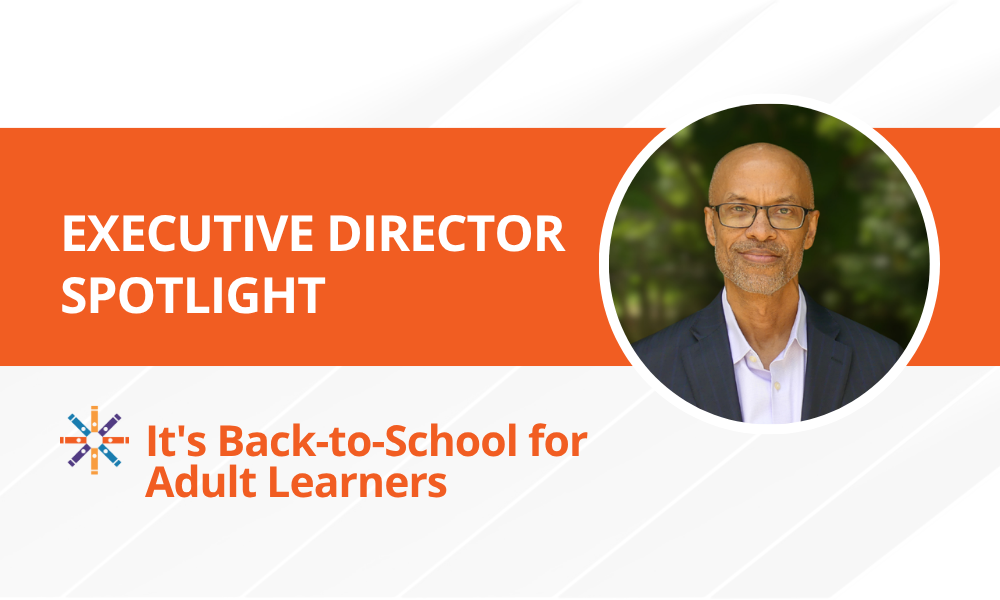
Graphic promoting an Executive Director Spotlight featuring Gerard Etienne and his recent blog.
By Gerard Etienne • August 25, 2026
I don’t remember my first day of high school very well, or even my first day in college, but I will never forget my first day of 8th grade or how I felt. My family and I had just arrived in the U.S. in late July, and while I had taken a year of English in the French school system, the only sentence I could say with a degree of confidence was “I don’t speak English”! I was enrolled at St. Michael’s in Silver Spring (a K-8 school that closed in 2012), and on that first day, I went up to the teacher before class started and told him, “I don’t speak English.” He said something back to me, but I didn’t understand what he said, and I went to sit back down. For the rest of that day, and many days after that, I did my best to figure out what to do, where to be, and how to navigate my day-to-day. To do my homework, I first had to use an English-French dictionary to translate it, then switch to a French-English dictionary to translate my thoughts to English. As difficult as that experience was, I realize that I was very lucky—I was young, I had a strong academic foundation, no financial responsibilities, no one to take care of, and I was immersed in English every day, all of which allowed me to learn the language relatively quickly. The situation for adults is very different. Many, if not most, have families to support, bills to pay, multiple responsibilities to manage, and have limited time to devote to taking English classes, all while navigating an increasingly challenging climate of immigration enforcement and economic uncertainty. Despite these challenges, thousands of adults across Montgomery County have the courage, perseverance, and determination to take classes year after year. They choose to invest in themselves even when doing so means fitting English around work schedules, childcare, transportation, and everything else life demands of them. I had the incredible advantage of being immersed in English every day and having most of my day devoted to learning. Most adults don’t have that luxury. As children go back to school this fall, it is worth remembering that thousands of adults are also heading to the classroom to improve their English, often after a full day of work or caring for their families. Their determination is remarkable and inspiring. We have the responsibility to make sure that every adult who wants to learn English has the opportunity, support, and access to do so.